
Author's posts
Jun 09
Seminar Highlight: Mpho Tladi on Stochastic Krylov Dynamics
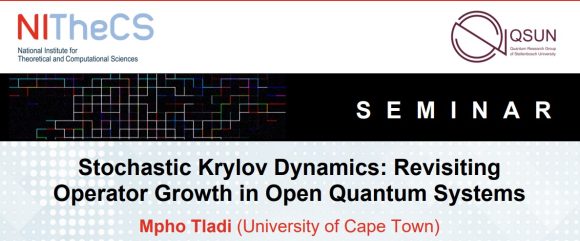
On Friday, 5 June 2026, Quantum@SUN and NITheCS hosted Mpho Tladi from the University of Cape Town for a seminar titled “Stochastic Krylov Dynamics: Revisiting Operator Growth in Open Quantum Systems.” The seminar explored one of the big questions in modern quantum physics: what happens to quantum information when a system is no longer isolated …
May 13
When Language Teaches AI Bias: A Quantum@SUN Seminar
Solomon Gizaw gave us a fascinating look into gender bias in natural language processing, using Amharic, the official federal language of Ethiopia, as the main case study. The big question behind the talk was simple but powerful: can language data itself carry gender bias before an AI model even starts making decisions? The answer was …
May 04
Exciting Visit and AI Policy Talk by Dr Solomon Gizaw at NITheCS
We are excited to welcome Dr Solomon Gizaw from Addis Ababa University, Ethiopia, who is currently based at the NITheCS offices at Stellenbosch University until 11 May 2026. During his visit, Dr Gizaw will give a talk titled “Analysis of Artificial Intelligence Policy Development in African Countries: A Policy Process Perspective” on Thursday, 7 May …
Apr 30
Celebrating Excellence in Computer Science at Stellenbosch University
We highlight William Marais, one of the top Computer Science Honours students at Stellenbosch University. After completing his Honours degree with an impressive 84% average, William has continued into advanced research under the supervision of Francesco Petruccione. His research lies at the intersection of quantum computing and machine learning, focusing on the use of evolutionary …
Mar 22
Quantum Effects in Microtubules: A NITheCS & QSUN Seminar
Dr Lea Gassab gave us a fascinating dive into Quantum Effects in Microtubules this week, exploring how tiny quantum phenomena could play a role in biology. The spotlight was on tryptophan, an amino acid that lights up under UV at 280 nm. Its transition has the dipole moment which makes it a perfect candidate for …
Mar 05
Echoes from Quantum@SUN: Divide and Conquer Simulation of Open Quantum Systems
On 8 August 2025, NITheCS hosted a Groundbreaking Colloquium at Stellenbosch University titled “Divide and Conquer Simulation of Open Quantum Systems,” presented by Dr Nadja K. Bernardes, a quantum physicist at the University of Porto. Dr Bernarde’s research explored on the building of practical quantum algorithms to simulate open quantum systems that interact with their environment. Her research …
Mar 05
Echoes from Quantum@SUN
Echoes from Quantum@SUN is a blog series that brings past Quantum@SUN seminars back into the spotlight. In this series, selected seminars are revisited and transformed into accessible articles, allowing readers to engage with the key ideas, discussions, and insights shared by our speakers. By reposting and reworking these past talks into written form, Echoes from …
Feb 25
Exploring Algorithms at the 16th CHPC & 8th NITheCS Coding Summer School

At the 16th CHPC & 8th NITheCS Coding Summer School on day 6, Prof Francesco Petruccione and Dipika Ramjugernath presented a session to participants and explored the core strategies that computer scientists use to solve complex computational problems efficiently. The presenters made a note to participants that not all computational problems are straightforward. Difficulty of …
Feb 09
Inside the QWorld Annual Meeting: Connecting a Global Quantum Community
The second QWorld Annual Meeting convened participants from around the world to discuss the growth and coordination of the QWorld network. Chairperson Paweł Góra opened the meeting by outlining its purpose: presenting QWorld and its regional “QWorld Cousins,” exploring the opportunities for quantum initiatives, and fostering community integration. The two-day event’s programme featured presentations from …
Feb 09
How Symmetry Helps Scientists Solve Difficult Wave Equation
Understanding the Challenge At the Dynamic Systems Workshop at Stellenbosch University, Dr Ali Raza explained how mathematicians solve the most complex wave equations in physics. These equations describe how vibrations, signals, and energy move in different environments. The problem is that once the wave equations become “nonlinear” the classic mathematical tricks no longer work. …
- 1
- 2