
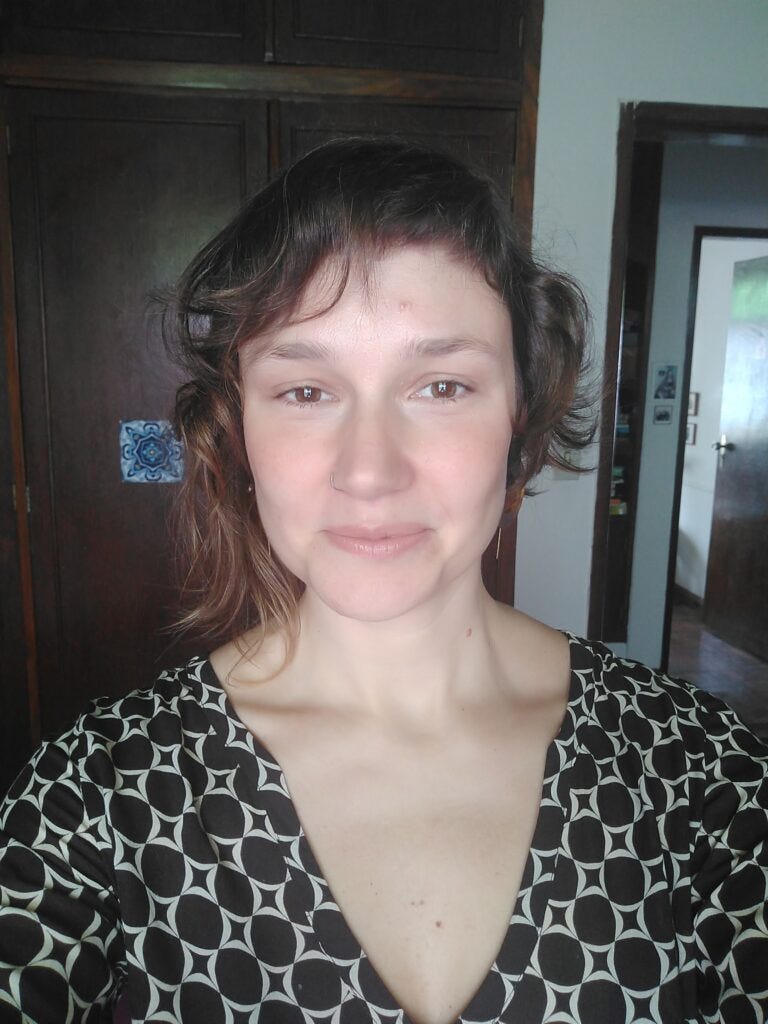
Photo by Nadja K. Bernardes
On 8 August 2025, NITheCS hosted a Groundbreaking Colloquium at Stellenbosch University titled “Divide and Conquer Simulation of Open Quantum Systems,” presented by Dr Nadja K. Bernardes, a quantum physicist at the University of Porto.
Dr Bernarde’s research explored on the building of practical quantum algorithms to simulate open quantum systems that interact with their environment. Her research combines mathematical precision with real hardware constraints, aiming to bring powerful simulations within reach of today’s quantum devices.
Why This Matters
The modeling of open quantum systems is very important for simulating real-world phenomena, from chemical reactions to biological energy transport. The problem? Traditional strategies were either too qubit-hungry or required extremely deep circuits, both impractical for current quantum hardware.
Dr. Bernardes introduced a flexible and unified strategy that turns two formerly separate approaches Stinespring dilation and Sz.-Nagy dilation, into a single, scalable framework. The result? Quantum simulations tailored to the capabilities of actual devices.
Key Takeaways
- Why Previous Experiments Fell Short
- Stinespring dilationis deterministic but demands a large number of ancilla qubits and hundreds of CNOT gates.
- -Nagy dilationis probabilistic—needing far fewer qubits—but must be repeated many times due to its inherent randomness.
Neither method scaled well on real quantum hardware. You had to pick your poison: fewer qubits or shallower depth—but not both.
- The New Strategy: Divide and Conquer
Dr Bernardes showed that these two methods are special cases of a more general dilation, defined by a tunable parameter L:
- Stinespring -L = M(maximum ancilla qubits)
- -Nagy – L = 1(minimum ancilla, maximum sampling)
By interpolating between them, you can choose the balance that works best for your hardware.
Need to save qubits? Increase the circuit depth.
Have more qubits? Reduce the sampling burden.
“You don’t have to pick one method. You can interpolate between them depending on what your quantum computer can handle”.
Q&A Summary
How Close Are We to Full Simulation?
Dr. Bernardes estimates that full simulations of complex systems are within reach—with proper optimization. Many theoretical models fail when directly implemented on hardware but tuning to device capabilities changes the game.
Can This Scale to the Avian Compass Model?
She noted that they attempted to simulate the avian compass model, related to birds’ magnetic navigation. While it remains a dream project, the Kraus operators were too large for current devices. However, she hinted that better operator grouping, or hardware-specific tuning might eventually make it feasible.
Personal Note
If you’d like to explore Dr. Bernardes’ ideas in more depth, you can watch the full colloquium on YouTube through the link below.
