Understanding the Challenge
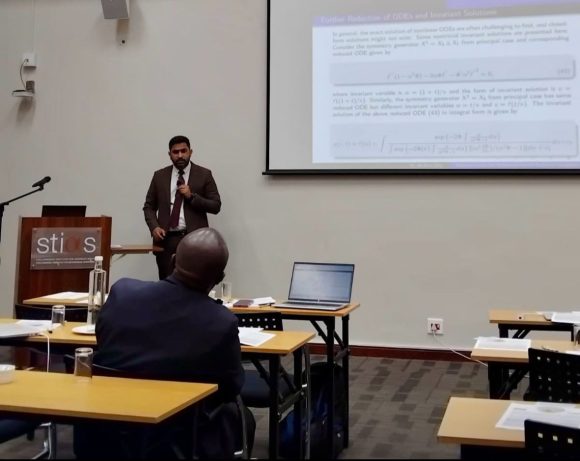
At the Dynamic Systems Workshop at Stellenbosch University, Dr Ali Raza explained how mathematicians solve the most complex wave equations in physics. These equations describe how vibrations, signals, and energy move in different environments. The problem is that once the wave equations become “nonlinear” the classic mathematical tricks no longer work.
Dr Raza addresses this problem using a technique developed in the 19th century by the mathematician Sophus Lie. The technique is straight forward: if an equation remains the same under a certain transformation, that transformation is called a symmetry. Symmetries completely simplify an equation, reducing the complexity to a form that is far easier to solve while still keeping its essential behavior.
Finding the ‘Optimal System’
An essential part of his research focuses on building an “optimal system,” which is a set of symmetries that captures the widest possible range of solutions. These optimal systems uncover new solutions that would usually remain hidden, especially in models that appear in biomembranes, engineering, and wave dynamics.
Why It Matters
Dr Raza’s recent work has been accepted for publication, drawing attention to the growing influence of symmetry-based methods. His talk showcased how deep mathematics continues to drive innovation across physics and applied science an important mission of Quantum@Sun
